
Регуляторы давления газа
Gas Pressure Regulators: Types and Purpose of Welding Regulators
Gas welding requires the use of a gas pressure regulator, or reducer, which allows precise and safe control of the gas flow to the welding torch. Regulators come in various types and are designed for different gas mixtures, such as oxygen, acetylene, propane, and carbon dioxide.
Key Functions and Features of a Welding Regulator
A regulator is a compact device responsible for adjusting gas pressure to a safe level for welding operations. It is an essential component of a welding semi-automatic machine that requires gas to create a protective layer over the welding area. Gas flows into the regulator under excess pressure, and most models are equipped with a safety valve to prevent damage to the device from sudden pressure spikes. However, if the regulator's working chamber can handle the input pressure without risk of damage, a valve may be unnecessary.
Operating Principle and Types of Regulators
The operating principle of a regulator depends on its type:
- Direct regulators – reduce gas pressure to an optimal level for delivery to the welding torch.
- Reverse regulators – work on a different principle: they increase excess pressure in certain situations and control the level inside the tank.
Types of Regulators by Welding Gas Mixture
Regulators are categorized based on the type of gas mixture they are designed for:
- Oxygen regulators – used for oxygen welding and cutting.
- Acetylene regulators – suited for acetylene, which is essential for welding and cutting.
- Air regulators – for working with regular air.
- Propane regulators – intended for use with propane.
Regulators are also differentiated by the thread direction for connecting to the torch: regulators for flammable gases have a left-threaded connection, while non-flammable gas regulators use a right-threaded connection. Semi-automatic machines and argon welding units typically require right-threaded regulators.
How to Choose a Welding Gas Regulator?
Selecting the appropriate regulator depends on the type of gas, indicated by color codes on the device itself:
- Black label with yellow text – for use with carbon dioxide (CO₂).
- Blue dot with black text – for oxygen regulators.
- White label with red text – for acetylene.
- Black label with white or blue text – for argon.
Gas cylinders also have specific color codes: for example, gray indicates an argon-filled cylinder.
Adjusting Regulators for Carbon Dioxide (CO₂)
Carbon dioxide regulators are equipped with an adjustment screw to set the tension of the main spring, allowing precise control of the output pressure. When the spring is loosened, the diaphragm lowers, adjusting the gas flow.
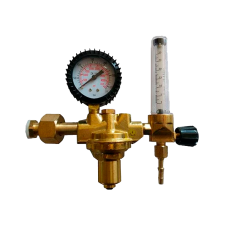
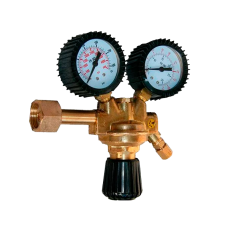
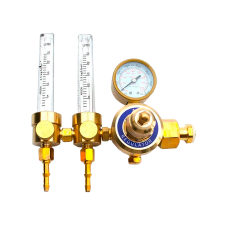
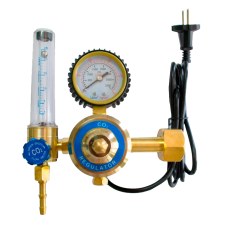
Most CO₂ regulators come with two pressure gauges: one displays the inlet gas pressure, while the other shows the outlet pressure. Some models are also equipped with a flow meter (rotameter) and a single gauge for precise gas flow control.
Gas pressure regulators are essential for safe and efficient gas welding. Reliable and correctly chosen regulators ensure stable results and ease of use, regardless of the task's complexity.